Entry point for the CNN training binary. More...
#include "src/cnn/cnn.h"#include "src/cnn/dataset.h"#include "src/cnn/model.h"#include <stdio.h>#include <stdlib.h>#include <string.h>#include <time.h>#include <sys/stat.h>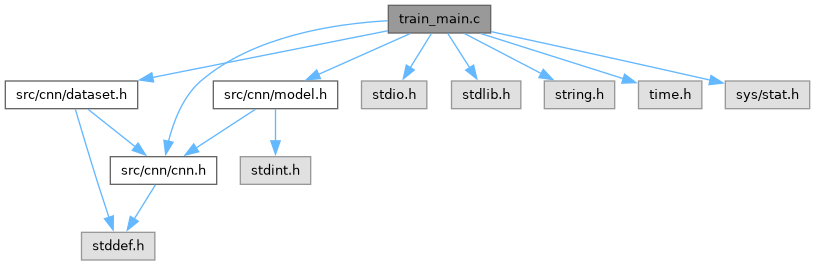
Classes | |
| struct | TrainArgs |
| Parsed command-line options for the train binary. More... | |
Macros | |
| #define | DEFAULT_DATA_DIR "training_data/" |
| #define | DEFAULT_MODEL_DIR "models/" |
| #define | MAX_EPOCHS 50 |
| #define | VAL_SPLIT 0.15f /* fraction of data kept for validation */ |
| #define | ES_PATIENCE 5 /* epochs without improvement before stopping */ |
| #define | ES_MIN_DELTA 1e-4f /* minimum val-loss improvement to count */ |
Functions | |
| static void | usage (const char *prog) |
| Print usage information to stderr. | |
| static int | parse_args (int argc, char **argv, TrainArgs *args) |
| Parse argv into a TrainArgs structure. | |
| static double | eval_loss (CNN *net, const Sample *samples, size_t n, double *out_acc) |
| Compute loss and accuracy on a slice of samples (no gradient update). | |
| static void | train_loop (CNN *net, Dataset *ds, int n_epochs) |
| Run the training loop with early stopping. | |
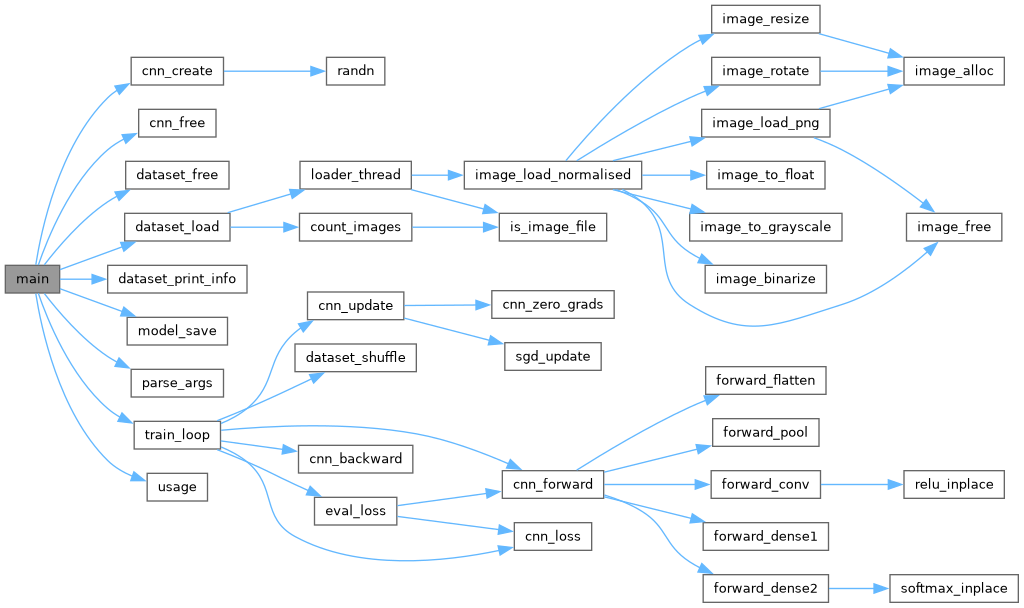
| int | main (int argc, char **argv) |
Detailed Description
Entry point for the CNN training binary.
Usage:
Options: –data <dir> Training data root directory (default: training_data/). –output <file> Output model filename (default: models/model_<ts>.bin). -j<N> Number of loader threads (default: 1).
Example:
Exit codes: 0 Success — model saved to the output path. 1 Argument error. 2 Dataset loading error. 3 Model save error.
Macro Definition Documentation
◆ DEFAULT_DATA_DIR
| #define DEFAULT_DATA_DIR "training_data/" |
◆ DEFAULT_MODEL_DIR
| #define DEFAULT_MODEL_DIR "models/" |
◆ ES_MIN_DELTA
| #define ES_MIN_DELTA 1e-4f /* minimum val-loss improvement to count */ |
◆ ES_PATIENCE
| #define ES_PATIENCE 5 /* epochs without improvement before stopping */ |
◆ MAX_EPOCHS
| #define MAX_EPOCHS 50 |
◆ VAL_SPLIT
| #define VAL_SPLIT 0.15f /* fraction of data kept for validation */ |
Function Documentation
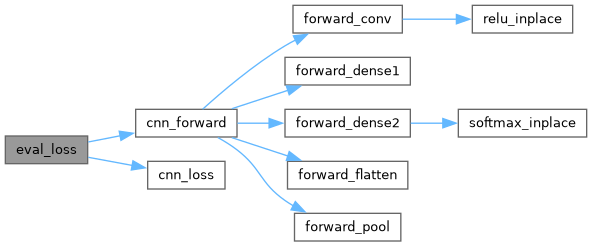
◆ eval_loss()
Compute loss and accuracy on a slice of samples (no gradient update).
- Parameters
-
net Trained CNN. samples Pointer to first sample. n Number of samples. out_acc Filled with accuracy in [0, 1].
- Returns
- Average cross-entropy loss.

◆ main()
| int main | ( | int | argc, |
| char ** | argv ) |
◆ parse_args()
|
static |
Parse argv into a TrainArgs structure.
- Parameters
-
argc Argument count. argv Argument vector. args Output structure (caller-allocated).
- Returns
- 0 on success, -1 on parse error.

◆ train_loop()
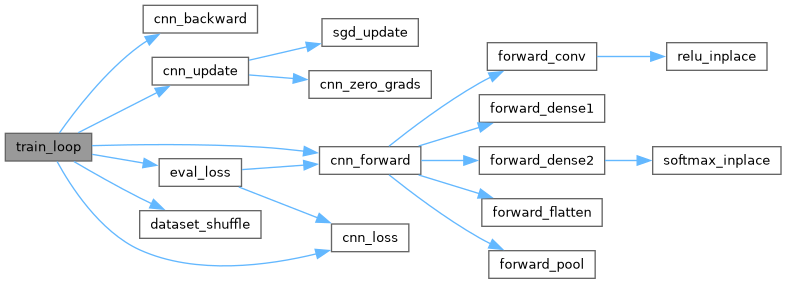
Run the training loop with early stopping.
The dataset is split into a training portion (1 - VAL_SPLIT) and a validation portion (VAL_SPLIT) after an initial shuffle.
Early stopping: training halts when validation loss has not improved by more than ES_MIN_DELTA for ES_PATIENCE consecutive epochs. The best weights observed so far are restored before returning.
- Parameters
-
net Initialised CNN. ds Full dataset (will be shuffled in-place). n_epochs Maximum number of epochs.

◆ usage()
|
static |
Print usage information to stderr.
- Parameters
-
prog Program name (argv[0]).